Soul Searching and Emotional Alchemy

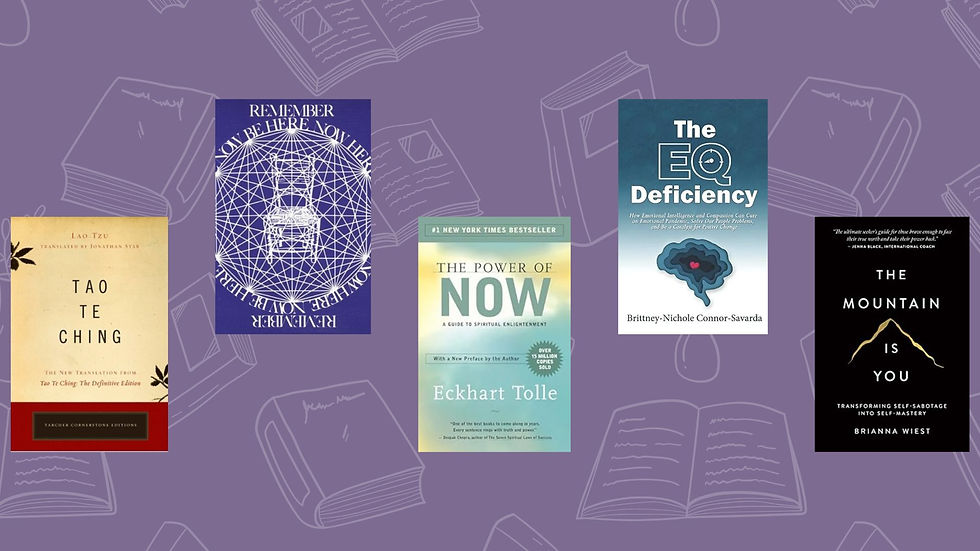
Personal development isn't about optimization or becoming a better version of yourself. The books that matter most invite us into honest self-examination, emotional literacy, and the courage to face what we've been avoiding. They're about integration, not improvement.
Tolle's central teaching is devastatingly simple: suffering exists in our mental narratives about the past and future, while life only exists in the present moment. This book isn't about mindfulness as a technique but as a fundamental shift in consciousness. Tolle guides readers through recognizing the ego's patterns, the pain-body's addiction to suffering, and the possibility of presence that exists beneath our thinking minds. Reading this book is less like learning something new and more like remembering what you've always known but forgotten.
Part memoir, part spiritual teaching, part psychedelic art experience, Ram Dass's iconic book chronicles his transformation from Harvard psychology professor Richard Alpert to spiritual teacher. The book is divided into sections that trace his journey and offer practices for awakening. What makes this book enduring isn't its specific techniques but its transmission of what it means to live with an open heart, to serve, and to see the divine in every interaction. It's a book that meets you where you are and invites you deeper.
I wrote this book because I kept seeing the same gap: people wanted to understand their emotions but didn't know where to start. Emotional intelligence isn't something most of us were taught—not at home, not in school. We're expected to navigate complex feelings, relationships, and triggers without a roadmap. This book offers that roadmap. It explores why we behave the way we do, how to recognize the needs behind our strongest emotions, and practical ways to work with feelings instead of against them. Whether you're trying to understand your reactivity, manage overwhelm, or simply get more comfortable with the full range of human emotion, this book meets you where you are and gives you tools that actually work in daily life.
Wiest writes about self-sabotage not as a character flaw but as a protection mechanism—your unconscious trying to keep you safe from something it perceives as threatening. This book examines the ways we block our own growth, not through willpower failures but through unexamined fears and beliefs. She explores emotional intelligence, how to process feelings rather than suppress them, and what it means to build a life aligned with your actual values rather than inherited ones. Her writing is both philosophical and immediately applicable.
LePera, a clinical psychologist known as "The Holistic Psychologist," wrote this book after recognizing that traditional therapy often fell short of creating lasting change. She explores how childhood experiences and family patterns live in our bodies and nervous systems, creating cycles we unconsciously repeat as adults. The book redefines trauma not as only catastrophic events but as any experience that overwhelmed our capacity to cope—including emotional neglect, having our feelings minimized, or growing up with emotionally immature parents. Through accessible explanations of attachment theory, inner child work, and nervous system regulation, LePera offers practical tools for recognizing your patterns, understanding where they came from, and choosing differently. This is essential reading for anyone working to break generational cycles and heal family patterns that no longer serve them.
This 2,500-year-old text offers 81 short verses on the nature of reality, power, leadership, and living in harmony with the Tao—the way of things. It's paradoxical, poetic, and can't be understood intellectually. Reading it regularly opens something in you that logic can't reach. It teaches through resonance rather than instruction: effortless action, yielding as strength, emptiness as fullness. Keep it by your bedside and read a verse each morning.
These books share a recognition that personal growth isn't linear or comfortable. They honor the wisdom in your symptoms, the intelligence in your resistance, and the possibility of becoming whole rather than perfect. They're companions for the inner journey, not instruction manuals for external success.


Good article with clear explanations and useful information. I like the idea of having a quick way to practice clicking without making the process complicated. You can check out this clicker test and make a few attempts. Comparing the numbers afterward gives you an easy way to see whether your clicking speed is changing with practice.
I really resonate with the idea of emotional alchemy! I've found that each tough experience has led me to deeper self-awareness. Slope Run It's empowering to transform pain into growth, isn't it?
An online gaming platform called BloxGames delivers the creativity and pleasure of Roblox-style games straight to your web browser. BloxGames is particularly appealing to casual gamers and younger audiences since it allows users to get right into a wide variety of games without the need for complicated installations or hefty downloads, unlike traditional Roblox Games sites.
Your post on emotional alchemy was incredibly thought-provoking. The way you explained the steps of self-reflection and transformation was very clear and engaging. I recently read a post on https://www.gourmetgiftbasketstore.com/ that touched on mindful and thoughtful gift-giving as a way to connect with others, which I found to be an interesting complement to your ideas about emotional awareness.
I was supposed to stretch after my workout, but I sat on the mat playing Block Blast instead. My muscles got sore, but that satisfying combo made me forget all about stretching.