Raising Children at the Edge of the Unknown

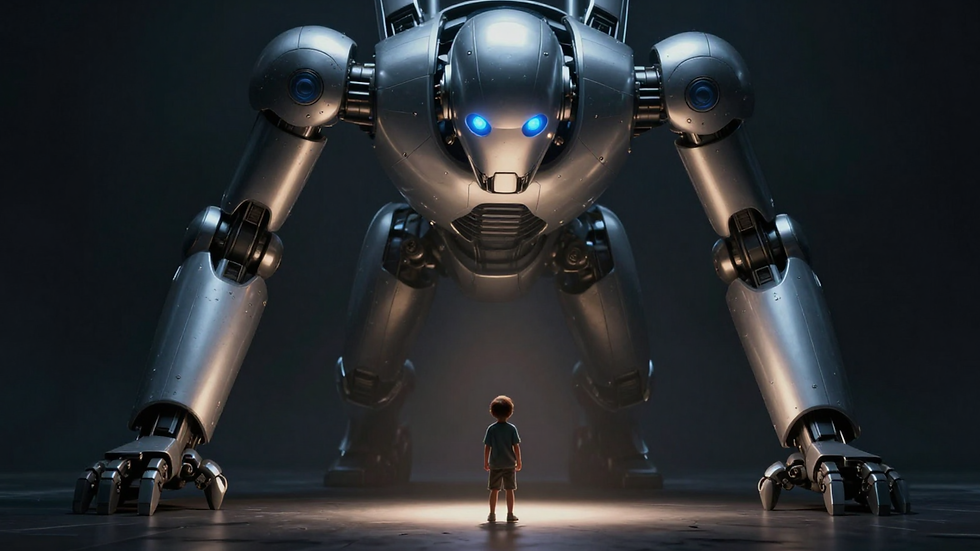
There is something quietly profound about watching a two-year-old discover the world. The way they study a leaf. The way they laugh before they have language for what is funny. The way they reach for you, not because they need something specific, but because you are their entire context for what is safe and what is real.
And then you look up from that moment and remember what world they are growing up in. And you feel two things at once — wonder and a weight you cannot quite name.
That tension is worth exploring honestly.
A Generation Unlike Any Before It
Gen Alpha spans 2010 to 2024. The oldest are sixteen. The youngest are toddlers. What they share is not an age but a formation — they are being shaped by conditions no previous generation encountered at the scale or speed now present. A pandemic reshaped the earliest developmental years for many of them. The years from birth to age five are critical to establishing healthy social and emotional behaviors, and COVID lockdowns disrupted that socialization in ways still unfolding — with a growing share of young children now showing mental, behavioral, or developmental challenges.
Gen Beta, born from 2025 onward, arrives into a world already transformed. For them, artificial intelligence will not be something they adapted to. It will simply be the texture of ordinary life — as assumed and unremarkable as electricity, present from the very beginning.
These are not just demographic labels. They are two generations of human beings whose inner lives, sense of self, and understanding of what is real are being formed inside conditions we are still trying to comprehend ourselves.
The Creativity Question
One of the deeper anxieties parents carry right now — often without articulating it — is about creative identity. We have long told children that their imagination, their originality, their ability to make something from nothing, is what makes them irreplaceable. Now AI generates art, writes stories, composes music, and produces ideas at a scale and speed no human can match.
This does not mean creativity is dying. It means we need to understand it more precisely than we did before.
Creativity was never really about output. It was always about the inner experience of making — the struggle, the discovery, the meaning a person finds in the process of bringing something into existence that wasn't there before. A machine can produce a painting. It cannot feel what it means to make one. That distinction is not small. It is everything.
What children need is not protection from AI. They need deep enough roots in their own inner life that they know the difference between a tool and themselves. They need experiences of making things with their hands, solving problems with their bodies, sitting with boredom long enough to discover what lives on the other side of it. These are not nostalgic indulgences. They are developmental necessities.
On Meaning in an Uncertain Future
At least 65% of Gen Alpha children are expected to work in jobs that don't yet exist. That statistic is sobering not because it suggests failure, but because it exposes the limits of the traditional roadmap parents have always handed their children. Study this. Pursue that. Build these credentials. The linear path from preparation to outcome is no longer as reliable as it once was.
This does not mean preparation is irrelevant. It means the nature of preparation has to shift. The most durable things we can give a child are not specific skills — though skills matter — but the capacity to learn, to adapt, to fail and return, to know themselves clearly enough to make decisions in conditions that have no precedent.
Meaning, for a child, is not found in a career trajectory. It is found in the experience of being seen, being loved, belonging somewhere specific, and feeling that their presence in the world matters to actual people in actual places. In a world that floods children with everything from conflict footage to environmental crisis before they have the emotional vocabulary to process it, what they crave — and need — is not more input but more presence.
That has always been true. It is simply more urgent now.
What We Can Actually Offer Them
We cannot give these children certainty. We cannot hand them a map that holds. What we can give them is something harder to quantify and more lasting in its effect.
We can model how to live with uncertainty without being destroyed by it. We can show them what it looks like to stay curious when things are confusing, to stay grounded when things are frightening, to remain human in the fullest sense of the word when the world is pushing toward the efficient and the automated.
A child who is raised with emotional honesty — who is allowed to feel the full range of human experience and has adults willing to sit in that with them — develops a relationship with their own inner life that no external disruption can take from them. That inner life is the foundation. Everything else is built on top of it.
We are raising children at the edge of something we cannot fully see. The most honest and most loving thing we can do is stop pretending we can see it — and instead make sure that whatever comes, they know who they are.
That is not a small thing. In the long run, it may be the only thing that holds.


This post definitely hit home for me! I often question how to instill resilience in my children, especially when faced block blast with the uncertainty.
I think one of the hardest parts of parenting is accepting that you won't always have the answers. Kids grow up in a world that's changing so fast, so I guess learning together is better than pretending we know everything. @geometrydashspam.com
I really valued how this article avoided overcomplicating what could have been a fairly straightforward set of steps here. The author kept the practical information clear and to the point, without unnecessary padding included anywhere. That simplicity made the advice easy to remember and apply without needing to reread anything afterward. Thanks for such a clear and refreshingly simple piece.
This article captures the uncertainty many parents experience while raising children in a rapidly changing world. I especially liked the focus on resilience and learning together. After reading thoughtful pieces like this, I usually take a short break with Quick Games before getting back to work. Thanks for sharing!
I appreciated how this piece balanced quick, immediate steps with more substantial guidance meant for longer-term progress over an extended period of time. The author gave readers something to try right away while building toward deeper improvement over a more sustained timeframe. That range is exactly what makes a guidance blog valuable both for quick fixes and for more meaningful, lasting change. Thanks for such a well-rounded and genuinely valuable piece.