Chronically Strong: The Emotional Toll of Being the Person Everyone Else Leans On

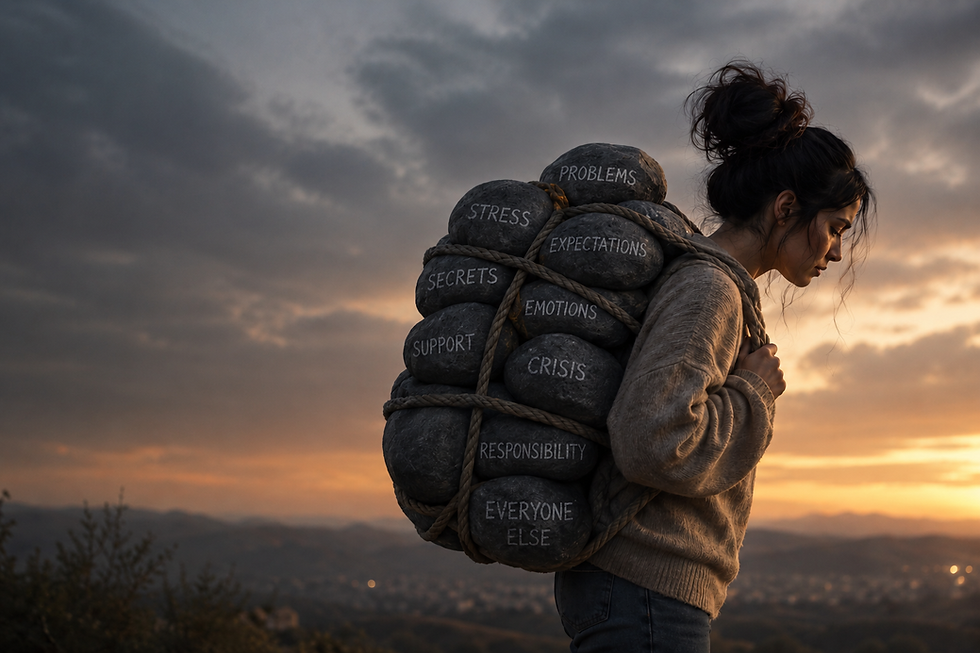
There is a particular kind of exhaustion that has no clean name and receives almost no public acknowledgment. It belongs to the person who is always the first called in a crisis. The one who manages the family emergency while also managing everyone's reaction to it. The friend who holds space for everyone's grief while quietly postponing their own. The colleague who absorbs the team's anxiety and converts it, somehow, into calm. These people are everywhere. They are often the most functional-looking people in any room. And they are frequently the most depleted.
Being chronically strong is not a personality trait. It is, in most cases, a deeply learned adaptation — one that often begins early. Many people who become the stable anchor in their adult relationships learned that role in childhood, in families where someone had to hold things together and the available candidates were limited. The child who kept the peace, managed a parent's moods, or became competent far ahead of their years often grows into the adult who cannot conceive of any other way to be. Strength is not just what they do. It is who they understand themselves to be. Which means that needing help, showing vulnerability, or admitting overwhelm can feel like identity collapse rather than a reasonable human response to being overextended.
The costs of this pattern are real and cumulative. Chronic suppression of one's own emotional needs in service of others is associated with elevated stress hormones, disrupted sleep, immune suppression, and a particular form of relational loneliness that is especially painful precisely because the person experiencing it is surrounded by people who love them. They are loved, often deeply — but they are not known. Because they have never allowed themselves to be seen in their difficulty, the relationships that surround them are warm but asymmetrical. Support flows outward. Almost none flows back. Not because the people in their lives are indifferent, but because those people have been trained, over years, to see this person as someone who does not need it.
The accountability dimension here runs in two directions. For the chronically strong person, the work is developing the capacity to receive — to ask for help without framing it as a temporary anomaly, to let people see the actual weight being carried, to resist the reflex of reassurance that immediately follows any moment of visible struggle. This is not weakness. It is one of the most demanding forms of courage available to someone whose entire identity has been organized around not needing it.
For the communities and relationships surrounding these people, the work is learning to look past the competence. To ask not just "can you help with this?" but "how are you actually doing?" — and then to wait, genuinely, for the real answer rather than accepting the reflexive "I'm fine" that arrives first. The people most skilled at holding others rarely volunteer their own distress. It has to be invited, consistently, over time, until they begin to believe the invitation is real.
Strength that is never replenished is not strength. It is depletion moving in slow motion. The most sustainable version of being someone others can rely on requires building a life in which you, too, are held — where the support is genuinely mutual, where your limits are acknowledged rather than exploited, and where the identity of "the strong one" is something you can occasionally set down without the whole structure collapsing. That version of strength is worth building. It is also, for many people, the hardest thing they will ever do.


Anyone researching p999 game download should consider the source as well as the technical requirements. Taking a moment to check both can help prevent compatibility problems and makes the installation process more organized from the beginning.
Some dordle puzzles seem easy from the first guess. You uncover a few letters, recognize the pattern, and suddenly both answers are sitting right in front of you.
In reality, life isn't a constant struggle to be the crutch for everything. Sometimes, we need to learn to let go of pressure, allow ourselves to be vulnerable, and seek peaceful moments to recharge. It's like putting aside your worries and relaxing by fishing in the tiny fishing game—gentle, stress-free, simply letting go and finding balance within yourself.
I usually play during coffee breaks, and Drive Mad fits perfectly. The levels are short but still feel satisfying to complete.
Speed Stars turns simple running into a demanding coordination challenge. Each stride is controlled through rhythmic tapping. The pace becomes more intense as speed builds. Mistakes can immediately disrupt your flow. Consistency is key to finishing strong. Every race offers room for improvement. Push for better records.