The Oldest War: How We Are Being Turned Against Each Other


There is a war being waged right now. It has no uniforms, no declared battlefields, no formal declaration. Its weapons are screens, algorithms, and the deepest levers of human psychology. And its most effective feature is this: most of the people fighting in it have no idea they've been enlisted.
Ask people anywhere what they actually want from life — not what they believe politically, but what they genuinely want. Safety. Opportunity for their children. Respect. Meaningful work. Enough security to sleep at night without their chest tight with worry.
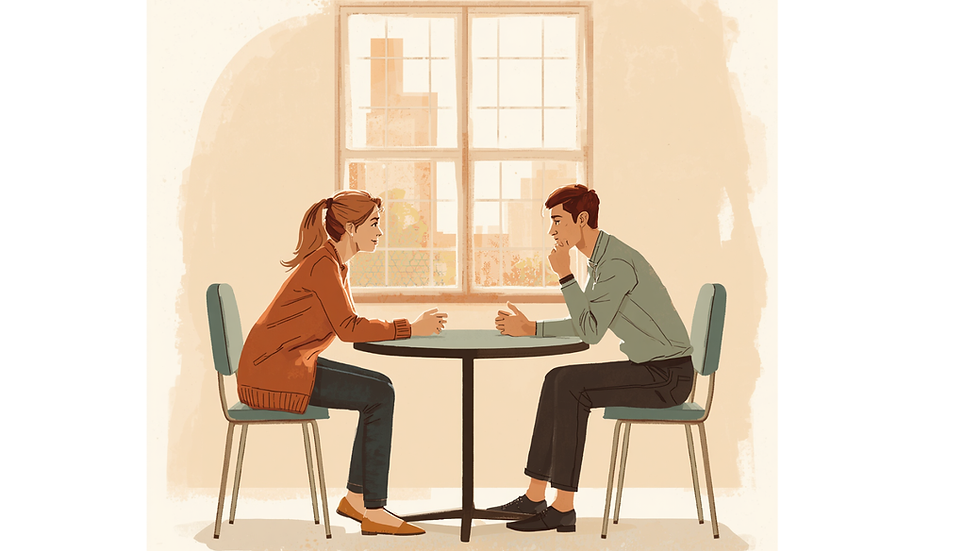
These desires have no political party. No race or religion. They are the shared architecture of being human. Studies in social psychology show repeatedly that when people from opposing "tribes" sit in real conversation — without their ideological labels — they find remarkable agreement on fundamental values. The differences that feel absolute from a distance become manageable, even trivial, up close.
So why does it feel like we are more divided than ever?
Chase Hughes is a behavioral expert and former military intelligence professional who has spent his career studying how humans are influenced and controlled. He makes one claim that should stop you cold: it is possible to brainwash someone — even the most intelligent, educated person in the room — in as little as 45 minutes. Not through torture or deprivation, but through precise, layered psychological technique.
His broader point is even more unsettling. The most powerful manipulation doesn't feel like manipulation. It feels like your own thoughts. It feels like clarity. It feels like finally seeing the truth.
Hughes explains that we are not rational creatures who occasionally feel things. We are emotional creatures who occasionally rationalize. And emotional states can be engineered.
Modern propaganda doesn't work by lying outright. It works by selecting which truths you see, amplifying them until they feel total, and attaching them to your sense of identity. Once a belief becomes part of who you are rather than something you simply think, challenging it feels like a personal attack. You stop questioning. You defend.
Look at the United States as a living example. Grocery bills are crushing families. Housing costs have become out of reach for an entire generation. Medical debt is burying people in the wealthiest nation on earth. These are not Republican problems or Democratic problems — they are human problems, felt across every state and every community with the same grinding force. The working mother and the young couple who cannot afford their first home are lying awake at night worrying about the exact same things.
And yet turn on the television. Open social media. Democrats blame Republicans. Republicans blame Democrats. Each side absolutely convinced that the other is the source of all suffering — that if we could only be rid of those people, everything would be fixed. Meanwhile, the bills keep rising. The wages stay flat. The powerful stay powerful. Nothing fundamentally changes, no matter which party holds office.
But do not mistake this for an American problem. The same script is playing out in the United Kingdom, where working-class communities are pitted against immigrants rather than the economic policies hollowing out their towns. In Brazil, where the poor are told their enemy is each other rather than the systems keeping them there. In France, Germany, India, and across Africa — the faces change, the languages differ, but the mechanism is identical. Find the fault line. Widen it. Keep people looking sideways.
The algorithm accelerates all of it everywhere. Platforms discovered early that outrage keeps people engaged far longer than contentment does. So people around the world are fed an endless stream of the most infuriating version of the other side, day after day, until their perception of their neighbors is built almost entirely from their worst moments. No one chose this diet. It was engineered. And it is making someone very rich while it pulls communities, nations, and people apart.
There is an old and grim observation shared across historians and political philosophers from every corner of the world: a society begins to fall when those in power turn its citizens against each other. When the people are too busy fighting one another to look upward, no one is watching the people in power.
This is what scholars call horizontal conflict. In a functioning society, grievances travel vertically — citizens hold power accountable, institutions are reformed, those at the top face real consequences for failure. But when accountability breaks down, pressure gets redirected sideways. Ordinary people blame other ordinary people for conditions they did not create. And those at the top, insulated from consequence, watch undisturbed.
Tocqueville saw it. Hannah Arendt saw it. Every serious student of collapsing orders across every civilization has noted the same pattern: once citizens become enemies of each other, they are no longer a threat to anyone who matters. They are simply exhausted. History is littered with societies that did not fall from outside invasion — they collapsed from within, because the people were too busy fighting each other to hold the right people accountable. Rome. The Ottoman Empire. Every great power that fractured did so only after its people forgot who the real problem was.
A conservative and a progressive. A Remain voter and a Leave voter. A ruling party supporter and an opposition supporter. Wherever you are in the world, the people on the other side of that divide share your rising costs, your crumbling services, your sense that the future is being quietly stolen. They are not your enemy. They are your mirror. But the machinery of division needs you never to realize that.
Both parties — in every country, under every flag — have held power. Both have made promises. The kitchen table looks the same after all of them.
Hughes puts the remedy plainly: the discomfort of recognizing that you've been influenced is the beginning of reclaiming agency. You cannot resist a force you refuse to acknowledge.
The first questions worth asking are: Who benefits from me believing this? Who benefits from my anger being aimed at that person, in that direction?
These are not comfortable questions. But they are the ones that free people ask — in every language, in every country, on every continent.
The people profiting from this horizontal war are not found in either political camp. They are found above all camps — and the single greatest threat to their position would be ordinary people, across every manufactured divide and every national border, recognizing what they share and asking together: how did we get here, and who truly benefited?
We were never as different as we were told.
The only question worth sitting with is: who needed us to believe we were?


Gracias por publicar información tan fácil de entender. Siempre resulta práctico disponer de recursos que permitan consultar los resultados sin complicaciones. Para quienes desean revisar los números de hoy, puede ser una opción interesante para encontrar información adicional y conocer resultados recientes.
Really enjoyed reading this! It's nice finding content that's useful and doesn't drag on forever. 👍 If you're into measuring hand-eye coordination and quick responses, the online reaction time test is worth trying. I like that it works instantly without needing to install anything.
Wow, this really hits home. It's so true how we get distracted from what truly matters. We all want to build a good life, right? Speaking of building, if you're ever tackling a roof project, a good roofing calculator can save so much hassle getting materials right.
wordle answer today The vibrant graphics make each stage visually lively. Timing and focus are essential for success.
Geometry Dash Lite offers thrilling gameplay with only one main control. The cube automatically moves across platforms and obstacles. Players must tap to jump at the right moment. Some sections include rings that allow extra jumps. The vibrant graphics make each stage visually lively. Timing and focus are essential for success.